
What is Paraiba Tourmaline? A complete guide to the world's three rare stones
paraiba tourmalineis an extremely rare tourmaline that was discovered in Paraiba, Brazil in 1987 and whose coloring factor is copper (Cu). Its unique hue, known as ``neon blue'' or ``electric blue,'' as if it were emitting light from within, is a feature not found in any other gemstone. Now"One of the three rarest stones in the world" along with Padparadscha sapphire and alexandriteIt is counted as one of the largest diamonds in the world, and it is not uncommon for the price per ct to exceed that of diamonds.
This guide provides a comprehensive explanation of everything you need to know, from those just starting to become interested in Paraiba to enthusiasts.
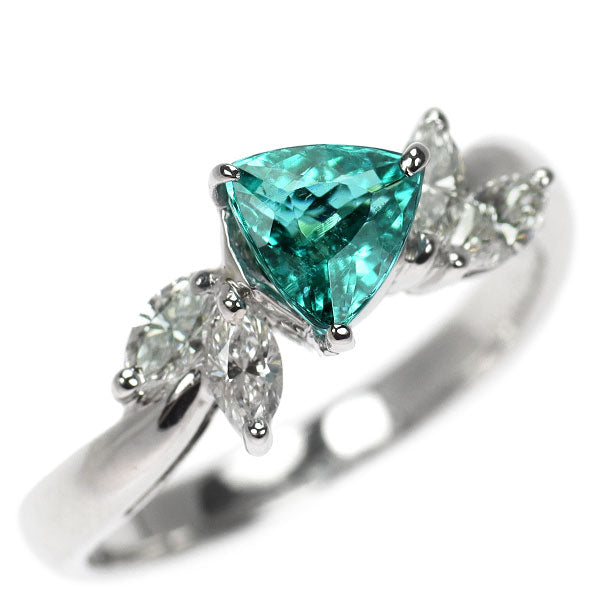
Comparison of vivid neon-colored Paraiba tourmaline at Selby
Each stone of Paraiba tourmaline has its own personality, depending on its color, such as neon blue or turquoise blue, its origin, and size. You can search for the item you like while checking the product information.
Compare by color
Check identification information
Status check OK
① Basic data of Paraiba tourmaline (mineralogy)
Figure 1: Schematic diagram of the crystal structure of Paraiba tourmaline
Classification as a mineral (elbaite tourmaline)
Paraiba tourmaline is a member of the tourmaline group mineralogically."Elbaite"belongs to. Among elbaite whose main component is lithium (Li), especiallyItems containing copper (Cu) and manganese (Mn)is called "Paraiba tourmaline". According to the regulations of the Laboratory Manual Harmonization Committee (LMHC), copper-containing elbaite can be called Paraiba tourmaline regardless of its origin.
Mohs hardness and toughness
Figure 2: Positioning in Mohs hardness
Mohs hardness is7.0〜7.5It is hard enough to withstand ring use. However, its toughness (resistance to cracking) is somewhat low, and care must be taken against strong impacts.
▶ For more details: Read S7 "Relationship between copper/manganese content values and color"② History of discovery in 1987
Figure 3: Timeline of Paraiba tourmaline discovery
The tenacity of Heitor Dimas Barbosa
The story of Paraiba Tourmaline is the story of a Brazilian miner.Mr. Heitor Dimas BarbosaIt all begins with the intuition that ``there is always a gem hidden here that no one has ever seen before.'' Since 1981, he has been working in the state of Paraiba in northeastern Brazil.batalha mineIn 1987, after more than 5 years, finallyelectrically glowing blue crystalsI found it.
Shocking debut at the Tucson show
In 1989, Paraiba Tourmaline was exhibited at the Tucson Show, the world's largest jewelry trade show, held in Arizona, USA, and its unparalleled neon blue color excited dealers around the world. The price jumped more than 10 times overnight, making it a debut that left a mark in the history of jewelry.
Comparison of vivid neon-colored Paraiba tourmaline at Selby
Each stone of Paraiba tourmaline has its own personality, depending on its color, such as neon blue or turquoise blue, its origin, and size. You can search for the item you like while checking the product information.
Compare by color
Check identification information
Status check OK
③ Science of neon blue color development
Figure 4: Mechanism of selective absorption by copper ions
Why does it look like it's glowing?
The biggest reason why Paraiba Tourmaline looks like it's shining is:Selective light absorption by copper ions (Cu²⁺)It is located in Copper ions strongly absorb red to yellow wavelengths while transmitting blue to green wavelengths, resulting in an extremely pure blue-green color. In addition, a small amount of manganese enhances absorption in the red region, resulting in a striking contrast and a luminous effect known as a "neon effect."
Miraculous balance of copper (Cu) and manganese (Mn)
| Ingredients | role | Estimated content |
|---|---|---|
| CuO (copper) | Mainly blue to green coloring | 0.5~2.5wt% |
| MnO (manganese) | Red region absorption/hue adjustment | 0.5~3.0 wt% |
| Cu/Mn ratio | Determine the hue (blue-ish or purple-ish) | 1.0 or higher, bright blue |
The exquisite balance between the two creates a neon blue color that is unique in the world.
📚 Source: From GSTV Gemological Research Institute, Dr. Ai Ahimadi "Research on Spectroscopic Analysis and Copper Content of Paraiba Tourmaline"
▶ Detailed explanation: S6 “Coloring mechanism of neon blue phenomenon” ▶ View numerically: S7 “Relationship between copper/manganese content and color”
④ Differences and characteristics by production area
Figure 5: Map of the world's major production areas for Paraiba tourmaline
Made in Brazil (Batalha, Mulungu, etc.)
| Production area | Features | Market evaluation |
|---|---|---|
| batalha mine | The deepest neon blue. High copper content. | ★★★★★(Top level) |
| mulungu mine | Bright turquoise color. High transparency. | ★★★★ |
| quintos mine | There are many hues that lean towards green. | ★★★★ |
Made in Africa (Mozambique, Nigeria)
Since the 2000s, copper-containing tourmaline has also been discovered on the African continent.Made in Mozambiqueare relatively large and bright blue,Made in NigeriaThe color tends to be green to turquoise, giving it a calmer impression than the Brazilian variety. The price is lower than that of Brazil, and it is popular among those who prefer large grains.
Comparison of vivid neon-colored Paraiba tourmaline at Selby
Each stone of Paraiba tourmaline has its own personality, depending on its color, such as neon blue or turquoise blue, its origin, and size. You can search for the item you like while checking the product information.
Compare by color
Check identification information
Status check OK
⑤ Color variations
Figure 6: Main hues of Paraiba tourmaline
Royal neon blue and turquoise blue
The most highly valued is high purity.neon blueand somewhat brightturquoise blueIt is. These appear in individuals with a high copper content and an ideal balance with manganese.
rare emerald green
Found in some parts of Batalhaemerald greenis a rare color that appears when the copper content is extremely high. It is a color that is coveted by collectors as there is little circulation.
Comparison of vivid neon-colored Paraiba tourmaline at Selby
Each stone of Paraiba tourmaline has its own personality, depending on its color, such as neon blue or turquoise blue, its origin, and size. You can search for the item you like while checking the product information.
Compare by color
Check identification information
Status check OK
⑥ Basics of processing and identification institutions
About heat treatment and impregnation treatment
Figure 7: Type of processing and impact on market value
How to choose a reliable identification agency
| Institution name | Location | Features |
|---|---|---|
| GIA | united states | The world's highest authority. The origin and processing determination are clear. |
| CGL (Central Gem Laboratory) | Japan | The largest company in Japan. Standards for domestic distribution in Japan. |
| Gübelin/SSEF | Switzerland | Focused on the European high-end market. |
| GGTL | europe | Accurate copper content analysis. |
⑦ Eitorita and the old mine (old stock)
A special stone called Eitorita
"Heitorita"is the name given to the old stock from the early Batalha mine, named after its discoverer, Heitor Barbosa. Current mines are virtually depleted and were mined in the earlyUnique neon blue specimenare rapidly disappearing from the market. It is now called a "phantom" and is attracting hot attention from both jewelry lovers and investors.
▶ Complete guide: S12 “What is the phantom Eitreta? The truth of the old mine Old Stock”⑧ Differences from other tourmalines
Figure 8: Relative market value by tourmaline variety
Difference in value between indigolite and rubellite
Even in the same tourmaline family,Indigolite (blue tourmaline)YaRubellite (red tourmaline)The biggest difference between Paraiba and Paraiba is the mineralogical uniqueness of the coloring caused by copper. Paraiba is sold for tens to hundreds of times more than other tourmalines, not only because of its flashy color, but also because of its small production volume and scientific rarity.
▶ Detailed comparison: S8 “Differences with other colored tourmaline varieties”⑨ Market value/purchase price
Why is it more expensive than diamond?
The market price of Paraiba tourmaline has increased due to the depletion of major production areas and the increasing demand for collectors.Rise more than 10 times in the past 20 yearsI'm doing it. In particular, it is not uncommon for unheated, unimpregnated Brazilian diamonds of 1 ct or more to far exceed the same carat weight for diamonds.
Current purchase market trends
| carat | Production area | quality | Purchase market price (reference) |
|---|---|---|---|
| Around 0.5ct | Made in Africa | standard blue | 50,000 yen - 200,000 yen |
| Around 1.0ct | Made in Brazil | neon blue quality | 500,000 yen to 2 million yen |
| 2.0ct or more | Made in Batalha | top quality | From 5 million yen |
| 3.0ct or more | Eitorita | phantom class | Negotiable (even over 10 million yen) |
*Market prices will fluctuate depending on market trends. Please use our free assessment for the most up-to-date and accurate assessment.
Comparison of vivid neon-colored Paraiba tourmaline at Selby
Each stone of Paraiba tourmaline has its own personality, depending on its color, such as neon blue or turquoise blue, its origin, and size. You can search for the item you like while checking the product information.
Compare by color
Check identification information
Status check OK
⑩ Enjoy with rings and jewelry
How to choose popular designs and metals
Figure 9: Combination of bullion and Paraiba
How to make the most of neon blueplatinumorwhite gold. On the other hand, if you are aiming for a complementary color effect,yellow goldis also a modern option. For engagement rings, eternity rings, pendants, etc., it is important to choose the base metal according to the purpose.
▶ Ring Special Feature: S2 “Charm of Paraiba Tourmaline Ring and How to Choose” ▶ Sales list: S1 “Paraiba tourmaline sales/selection guide”⑪ Points to note when purchasing
Checking the identification report and analysis table
When purchasing Paraiba Tourmaline, be sure to check the following three points:
- Issuing agency of certificate of identification ── Is it a trusted institution such as GIA, CGL, GGTL?
- Processing notation ─ Heat only or presence of impregnation (Clarity Enhancement)
- Analytical value of copper content ── Numerical values of CuO and MnO that serve as the basis for estimating the production area
⚠️ Attention: Paraiba that has been impregnated with resin has a lower value than it appears. Be sure to check the latest analysis table.
⑫ Frequently asked questions (FAQ)
Why is Paraiba tourmaline more expensive than diamond?
This is because the amount produced is extremely small and it is considered one of the three rarest stones in the world. In particular, high-quality loose pieces from the Batalha mine in Brazil can cost several million yen per carat.
Which is better, Brazilian or African?
It's not so much "good" or "bad" as it is a difference in direction. The ones from Brazil have a high copper content and tend to have a strong neon feel, while the ones from Africa tend to have large grains and a calm blue color. The price is higher for Brazilian products.
How can I tell if Paraiba has been impregnated?
It is difficult to identify with the naked eye, so the only sure way is to check the latest identification report from a reliable identification organization such as GIA or CGL.
Is Paraiba tourmaline worth the investment?
Prices have increased significantly over the past 20 years due to the depletion of production areas, and Brazilian, unheated, and certified specimens are said to be particularly valuable. However, market liquidity is limited, so it is important to trade with a reliable specialty store.
Does Paraiba change color?
Although the color is basically stable, please avoid long-term exposure to strong heat, UV rays, and chemicals. The color will not change with daily use.
Comparison of vivid neon-colored Paraiba tourmaline at Selby
Each stone of Paraiba tourmaline has its own personality, depending on its color, such as neon blue or turquoise blue, its origin, and size. You can search for the item you like while checking the product information.
Compare by color
Check identification information
Status check OK