
Sapphire is not the only blue gemstone. In this article, we will compare the names, Japanese names, stone words, and hardness of 11 representative blue gemstones with illustrations, and explain how to choose one according to the color and purpose. This article will help beginners who are considering a blue gem ring or gift to choose the stone that suits them with confidence.
Buyer for the Komehei Group's only company specializing in jewelry. In addition to supervising the e-commerce, SNS, loose, and product production departments, he is also in charge of purchasing rare stones. He specializes in determining authenticity and evaluating value, and works to protect consumers and improve market transparency by disseminating gemological information.
Summary in 30 seconds
- The representative of the blue gem isSapphire, tanzanite, aquamarine, blue topaz, lapis lazuli5 types.
- For rare blue gemstonesParaiba tourmaline, auinite, benitoite, blue diamondThere is.
- The colors can be roughly divided into ``dark blue (sapphire, lapis lazuli),'' ``bright blue (aquamarine, blue topaz),'' and ``vivid blue (Paraiba tourmaline, auynite).''
- The ring you wear every dayMohs hardness 7 or higher(sapphire, topaz, aquamarine, etc.) is one guideline. Hardness is an indicator of scratch resistance, and resistance to cracking (toughness) is considered separately.
- At the time of purchaseDistinction between natural, synthetic, and processedandIs there a certificate of identification?The trick to not making mistakes is to check.
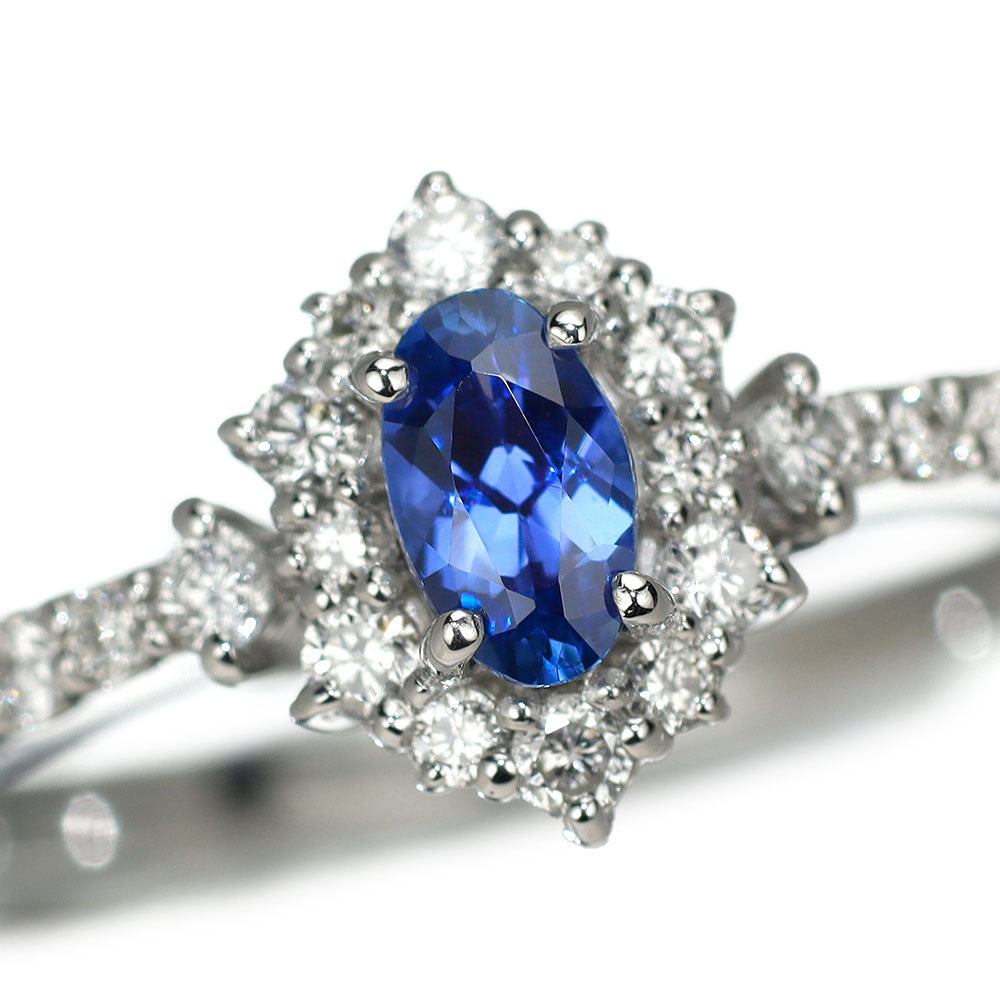
Comparison of blue sapphires, the royal road to blue gemstones, at Selby
Blue gemstones have very different impressions depending on their hue, from pale blue to deep navy blue. You can search for the most popular sapphires by comparing their color, design, price, and condition.
What is a blue gem? Why it turns blue
Blue gemstones are a general term for gemstones that exhibit a blue color due to trace elements such as iron, titanium, copper, and boron, as well as the unique structure of minerals, and representative examples include sapphire, tanzanite, and aquamarine.Even though it is the same "blue", its hue can vary greatly, from dark blue to neon blue, depending on the types of elements and minerals it contains. Therefore, choosing a blue gemstone starts with knowing what kind of blue you like.
For example, the blue of sapphire is said to be derived from iron and titanium, the blue of aquamarine is derived from iron, and the neon blue of Paraiba tourmaline is said to be derived from copper (source: GIA). Blue diamonds are reported to exhibit blue color due to the presence of boron. In other words, "Blue Gem" is not the name of a single stone;A group of gemstones with different origins and mineralogyIt is.
List of types of blue gemstones [11 representative types]
The 11 representative blue gemstones are sapphire, tanzanite, aquamarine, blue topaz, lapis lazuli, iolite, blue zircon, Paraiba tourmaline, benitoite, blue diamond, and auinite.There is a wide range of stones, from easily available stones to stones that are rare all over the world. First, let's check the overall picture in the list, and then look at the characteristics of each type with illustrations.
| Gem name | Japanese name | mineral species | mohs hardness | color trends | Stone words (tradition) | birthstone |
|---|---|---|---|---|---|---|
| sapphire | Seigyoku | corundum | 9 | dark blue to bright blue | Sincerity, Charity, Virtue | september |
| tanzanite | Greystone | Zoisite | 6〜7 | Blue-purple to dark blue | Mysterious, noble, calm | december |
| aquamarine | Rangyoku | beryl | 7.5〜8 | pale and bright light blue | Calm, brave, intelligent | March |
| blue topaz | Ougyoku | topaz | 8 | light blue to dark blue | friendship, hope, innocence | November (Topaz) |
| lapis lazuli | Ruri | Aggregate rocks such as lazurite | 5〜5.5 | opaque dark blue | truth, health, luck | december |
| iolite | Cordierite | cordierite | 7〜7.5 | violet blue | Honesty, chastity, showing the way | - |
| blue zircon | Hiyashinsuseki | zircon | 6〜7.5 | bright blue with strong shine | peace/success | december |
| paraiba tourmaline | Tourmaline (denkiseki) | copper tourmaline | 7〜7.5 | neon blue | Hope/Homecoming | October (Tourmaline) |
| Benitoite | Benito stone | Benitoite | 6〜6.5 | blue with strong dispersion | Purification/encounter | - |
| blue diamond | Vajra stone | diamond | 10 | Pale blue to grayish blue | Eternal bond/unyielding | April (Diamond) |
| Hau night | Ranpouseki | Auin | 5.5〜6 | vivid deep blue | - (No established stone words) | - |
Sapphire (blue gemstone) | The royal road to blue gemstones
Sapphire is a corundum gemstone that has a blue color due to containing iron and titanium, and is a typical blue gemstone that is suitable for everyday wear rings due to its high hardness of 9 on the Mohs scale.It is second only to diamond in hardness and is scratch resistant, making it the choice for engagement rings and everyday jewelry. Myanmar, Sri Lanka, and Madagascar are known as major producing regions (Source: GIA).
Japanese name: Seigyoku / Mineral: Corundum / Mohs hardness: 9 / Stone language: Sincerity, charity, virtue / Birthstone: September
Heat treatment for color stabilization is widely used and is treated as a common treatment in the industry. On the other hand, unheated sapphires that have a beautiful blue color are rare, and those that have a certificate that states "no traces of heating" are highly valued.
Tanzanite (Greystone) | Mysterious stone with shimmering blue and purple colors
Tanzanite is a blue variety of zoisite discovered in the Merelani mining area of Tanzania in 1967, and its most attractive feature is its pleochroism, which alternates between blue and purple depending on the viewing angle.It became known worldwide after Tiffany & Co. gave it the name "Tanzanite" (Source: GIA). Commercial production is said to be concentrated in very limited areas in Tanzania.
Japanese name: Kairenseki / Mineral: Zoisite / Mohs hardness: 6-7 / Stone language: Mysterious, noble, calm / Birthstone: December
Most of the tanzanite on the market is said to have developed a blue color through heating. Its hardness is lower than sapphire, and care must be taken with impact and ultrasonic cleaning, so it is more suitable for pendants and earrings than rings.
Aquamarine | Pale blue reminiscent of the sea
Aquamarine is a blue variety of the same beryl mineral as emerald, and is the birthstone for March, characterized by its transparent light blue color.The name is said to come from the Latin word for "water of the sea," and as the name suggests, it's calm and clear blue color is appealing. The blue color is reported to be due to trace amounts of iron (source: GIA).
Japanese name: Rangyoku / Mineral: Beryl / Mohs hardness: 7.5-8 / Stone language: Deposit, bravery, intelligence / Birthstone: March
Many stones have high hardness and few inclusions, making them suitable for rings for everyday use. It is said that a heat treatment is commonly used to remove the green tinge and adjust the blue tinge.
Blue topaz (yellow jade) | Bright blue that is easy to pick up
Blue topaz has a high hardness of 8 on the Mohs scale, but is also affordable, making it an easy choice as a first blue gemstone.The darkness of the color is distinguished by its distribution names: pale ``Sky Blue,'' bright ``Swiss Blue,'' and deep ``London Blue.''
Japanese name: Ougyoku / Mineral: Topaz / Mohs hardness: 8 / Stone language: Friendship, hope, innocence / Birthstone: November (as topaz)
Most of the blue topaz on the market is said to be colorless topaz that has been exposed to radiation and heated to develop a blue color (source: GIA). This is a common process that creates a stable color, and it is said that there is no problem with the safety of products that are properly managed, but it is important to know that there are very few topaz that exhibit a deep blue color in their natural state.
Lapis lazuli (lapis lazuli) | A dark blue stone that has evolved with history
Lapis lazuli is an opaque rock made of a mixture of multiple minerals, mainly lazurite (blue goldstone), and is characterized by its dark blue color, with golden pyrite shining like stars in the night sky.The main difference between it and other blue gemstones is that it is a rock rather than a single mineral. It was also used in ornaments in ancient Egypt and Mesopotamia, and is prized in Japan as one of the Buddhist cloisonnés. Afghanistan is known as the main historical production area (Source: Smithsonian).
Japanese name: Ruri / Composition: Aggregate rock such as lazurite, calcite, pyrite / Mohs hardness: 5-5.5 / Stone language: Truth, health, luck / Birthstone: December
Iolite (cordierite) | Intellectual blue with violet hues
Iolite is a cordierite gemstone with strong pleochroism that changes from blue to violet to pale yellow-gray depending on the viewing direction.Because of this property, there is a legend that the Vikings used it as a tool to determine the position of the sun during their voyages. The calm blue color has also been called "water sapphire."
Japanese name: Cordierite / Mineral: Cordierite / Mohs hardness: 7 to 7.5 / Stone Words: Showing honesty, chastity, and the path
Blue zircon (Fushinshi stone) | Brilliance approaching diamond
Blue zircon is a gemstone made from the natural mineral zircon, which has strong dispersion that divides light into rainbow colors and shines brightly among blue gemstones.Although it is often confused with the artificial stone cubic zirconia, zircon is a completely different natural mineral. Most of the blue colors on the market are said to be colored by heating brown zircon from countries such as Cambodia (Source: GIA).
Japanese name: Hiyashinsuseki / Mineral: Zircon / Mohs hardness: 6-7.5 / Stone language: Peace, success / Birthstone: December
Paraiba tourmaline (tourmaline) | Neon blue that surprised the world
Paraiba tourmaline is a tourmaline that exhibits a fluorescent neon blue color due to the presence of copper.Since it was discovered in the Brazilian state of Paraiba in the 1980s, high-quality stones have become one of the most highly traded colored stones in the world.Its unique color is called "Paraiba Blue," and it is characterized by its luminous brightness, which is not found in other blue gemstones (Source: GIA). Currently, copper-containing tourmaline, which is treated as Paraiba tourmaline, is produced not only from Brazil but also from Nigeria and Mozambique.
Japanese name: Tourmaline / Mineral: Copper-containing tourmaline (tourmaline containing copper and manganese) / Mohs hardness: 7 to 7.5 / Stone language: Hope, homecoming / Birthstone: October (as tourmaline)
Benitoite (benitoite) | Gemstone quality can only be found in one source
Benitoite is one of the rarest blue gemstones in the world, and its gem-quality crystals have only been commercially mined in San Benito County, California, USA.Discovered in 1907, it was designated California's "state gem" in 1985. It has a strong dispersion comparable to that of diamond, and is known to fluoresce blue-white under ultraviolet (short wave) light (Source: Mindat, Smithsonian).
Japanese name: Benitoseki / Mineral: Benitoite / Mohs hardness: 6-6.5 / Stone language: Purification, encounter
Blue Diamond | The pinnacle of natural colored diamonds
Blue diamonds are natural diamonds that exhibit a blue color due to the presence of trace amounts of boron, and are considered to be particularly rare among colored diamonds.The "Hope Diamond" owned by the Smithsonian Museum is world famous (Source: Smithsonian). It has been reported that the auction price for each carat is the highest for any gemstone.
Japanese name: Kongoseki / Mineral: Diamond / Mohs hardness: 10 / Stone language: Eternal bond, indomitable / Birthstone: April (as a diamond)
Auinite | Vibrant blue that captures the eye even with small grains
Auinite (Auin) is a gemstone of the mineral Auin that belongs to the sodalite group, and is a rare stone characterized by its vivid and deep blue color, which stands out even in small particles.It is said to be named after the French crystallographer Haüy. Gem-quality crystals are known to come mainly from the Eifel region of Germany, and because large crystals are rarely found, most of the loose crystals in circulation are small grains of less than 0.5 carat (Source: Mindat).
Japanese name: Ranpouseki / Mineral: Auin (sodalite group) / Mohs hardness: 5.5-6 / Stone language: - (No established stone language has been confirmed)
Other blue gemstones|There are still many variations of “blue”
In addition to the 11 types listed above, there are many other types of blue gemstones. We will introduce a simple list of typical ones.
| Gem name | Japanese name | mohs hardness | Features |
|---|---|---|---|
| apatite | Apatite (Rinkaiseki) | 5 | There is also a bright neon blue. soft and easily damaged |
| kyanite | Blue crystal | 4.5〜7 | It has the unusual property of having different hardness depending on the direction. |
| indigo light | Tourmaline (denkiseki) | 7〜7.5 | Indigo tourmaline. calm deep blue |
| Larimar | Sokei wollastonite | 4.5〜5 | From the Dominican Republic in the Caribbean. The white pattern looks like waves |
| turquoise | Turquoise | 5〜6 | Opaque sky blue. One of December's birthstones |
Comparison of blue sapphires, the royal road to blue gemstones, at Selby
Blue gemstones have very different impressions depending on their hue, from pale blue to deep navy blue. You can search for the most popular sapphires by comparing their color, design, price, and condition.
Choose blue gemstones based on their color | Compare dark blue, bright blue, and transparency
It is easy to choose blue gemstones by dividing them into four types: ``dark blue,'' ``bright blue,'' ``vivid blue,'' and ``opaque blue.'' The representative examples are sapphire for dark blue, aquamarine for bright blue, Paraiba tourmaline and auinite for vivid blue, and lapis lazuli for opaque blue.Even the same blue can have very different impressions, so you can narrow down your options by first deciding on your favorite color type. Get the full picture with the color map and quick reference chart below.
A jewel with an attractive dark blue color
If you like dark blue that draws you in deeply,sapphire tanzanite lapis lazuliis a candidate. A transparent dark blue is sapphire, a shimmering blue-purple color is tanzanite, and an opaque matte dark blue is lapis lazuli.Even the same ``dark blue'' has different expressions. Suitable for formal attire and those looking for a calm, mature impression.
A bright blue gemstone
If you are looking for a refreshing and light impression,Aquamarine, blue topaz, blue zirconis a candidate. Aquamarine is a pale and gentle light blue, blue topaz can be selected from sky blue to London blue, and blue zircon has a strong shine. The color is easy to match with casual clothes.
Gemstones with vibrant colors and brilliance
If you value the color and special feeling of the stone itself,Paraiba tourmaline, auinite, benitoite, blue diamondis the top choice. All of them have a low distribution volume and are expensive, but the neon blue color (Paraiba), the vivid blue that stands out even in small particles (auinite), the iridescent dispersion (benitoite), and the unique shine of diamonds (blue diamond) cannot be replaced by other stones.
| Color type | representative gems | impression | Recommended for these people |
|---|---|---|---|
| dark blue (transparent) | sapphire, tanzanite | Elegant/Formal | I want a standard item that can be used for a long time. |
| dark blue (opaque) | lapis lazuli | unique/exotic | I want to enjoy history and storytelling. |
| bright blue | aquamarine, blue topaz | Refreshing and gentle | Everyday use/first blue gemstone |
| Blue with emphasis on shine | blue zircon, benitoite | Glittering | I want to choose based on the strength of the shine |
| Vivid blue/neon blue | Paraiba tourmaline, auinite | Unique/rare | I want to invest in a special stone |
| blue-purple | tanzanite, iolite | mysterious | I want to enjoy blue that is different from other people. |
Blue gems chosen by stone words
When choosing blue gemstones based on stone language, sapphire is representative for "honesty," aquamarine and tanzanite are representative for "intelligent/calm," and lapis lazuli and blue zircon are representative for "healing/luck."Stone words are based on ancient folklore and culture, and although they do not guarantee scientific effectiveness, they are still widely used as clues for expressing feelings in gifts.
A jewel that symbolizes honesty and trust
Sapphire (honesty, charity, virtue) and iolite (honesty, chastity)is considered to be representative. Sapphire has long been a favorite of clergy and royalty, and has been a symbol of unwavering integrity. It is chosen as a gift for occasions when you want to convey trust, such as wedding anniversaries and engagement rings.
A gem symbolizing intelligence and calmness
Aquamarine (calm and intelligent) and Tanzanite (calm and noble)is considered to be representative. The calm blue is said to be a calming color, making it a perfect gift for someone who is starting a new life or changing jobs.
A gem symbolizing healing and good luck
Lapis lazuli (luck/truth), blue zircon (peace/success), blue topaz (friendship/hope)is considered to be representative. Lapis lazuli in particular has a history of being treated as a ``sacred stone'' around the world, and is a gemstone that many people wear as a talisman.
If you're looking for a birthday gift, we recommend choosing from birthstones. Blue gemstones are often used as birthstones, and December in particular is so concentrated that it can be called the "month of blue birthstones."
Points to consider when choosing blue gemstones
There are four points to keep in mind when choosing a blue gemstone: ``Is the hardness and toughness appropriate for the purpose?'' ``Is it natural, synthetic, or treated?'' ``Does it come with a certificate of authenticity?'' and ``Is it a reliable source?''Especially if it is a ring that you will wear every day, it is essential to check not only the color preference but also the hardness and durability. Let's check them in order.
Point 1: The ring should have a Mohs hardness of 7 or higher, and toughness and cleavage should also be considered.
Mohs hardness is a measure of scratch resistance. Dust in the air contains quartz with a hardness of about 7,One guideline for rings that you wear every day is a hardness of 7 or higher.It is common to do so. Sapphire (9), topaz (8), and aquamarine (7.5-8) are suitable for everyday use, while tanzanite (6-7), ouinite (5.5-6), and lapis lazuli (5-5.5) are suitable for pendants and special occasion jewelry.
However,High hardness does not necessarily mean strong impact resistance.Resistance to scratches (hardness) and resistance to cracking (toughness) are different properties; for example, topaz has a hardness of 8, but is said to have "perfect cleavage" that makes it easy to break in certain directions. The key to enjoying your jewelry for a long time is to aim for a hardness of 7 or higher, and also check the cleavage, toughness, and structure of the stone set (is the corner protected by a claw or ring)?
Point 2: Know the difference between natural, synthetic, treated, and imitation
The shortcut to determining whether a gem is genuine or not is to first understand the four classifications of gemstones.Synthetic stones and treated stones are not “fake” and are legitimate products if labeled correctly.It is. The problem is when these products are falsely sold as natural and unprocessed.
| classification | Content | example | value trends |
|---|---|---|---|
| Natural (untreated) | Color and clarity as mined | unheated sapphire | Tends to be rated highest in comparable quality comparisons |
| Natural (with treatment) | Improve color by heating, irradiation, etc. | Lots of heated sapphire, blue topaz, tanzanite | There is a range depending on the treatment content and quality (there are cases where high-quality treated stone outperforms untreated low-quality stone) |
| synthetic stone | Artificially crystallized ingredients that are the same as natural ingredients | Synthetic sapphire (Bernoulli method, etc.) | significantly lower than natural |
| Imitation stone (imitation) | Different material with similar appearance | blue glass, cubic zirconia | It has almost no value as a jewel. |
Point 3: Check whether there is a certificate of identification and what it says.
A certificate of authenticity is a document that shows through scientific testing what kind of mineral the stone is and what kind of treatment it has been treated with.It is. Its role is different from that of a "certificate of authenticity" (diamond grading report), which indicates the grade of quality. When purchasing blue gemstones that cost more than a certain amount, check to see if they come with an identification certificate from a reliable domestic identification organization (Central Gem Research Institute (CGL, GIA, etc.)) and to see if the treatment (heating, irradiation, impregnation, etc.) is included.
Point 4: Reason for the price difference between handmade products and branded products
At flea market apps and handmade markets, ``natural stone blue rings'' can be sold for several thousand yen.Cheap doesn't necessarily mean fake, but there is always a reason for the price.Most of the cheap blue gemstone rings generally fall into one of the following categories: (1) The material itself is cheap, such as blue topaz or dyed stone, (2) Synthetic stones or glass are used, and (3) The base metal is plated or alloyed. On the other hand, the price of branded products includes the cost of stone grade selection, precious metal ingot, warranty, and after-sales service.
Point 5: When in doubt, use the flowchart to narrow it down
Blue Gem Frequently Asked Questions (FAQ)
What is the representative blue gemstone?
The most typical blue gemstone is sapphire. The next most well-known are tanzanite, aquamarine, blue topaz, and lapis lazuli. If rarity is important to you, Paraiba Tourmaline, Ouinite, Benitoite, and Blue Diamond are blue gemstones that are highly valued around the world.
Which is better, sapphire or tanzanite?
If you're looking for a ring to wear every day, we recommend sapphire, which has a hardness of 9 on the Mohs scale, and if you're looking for a unique color, we recommend tanzanite. Tanzanite is delicate with a hardness of 6 to 7, but its pleochroism of blue and purple is a charm that sapphire does not have. The trick is to choose according to the purpose (daily use or special occasion).
What is the darkest blue gemstone?
Among transparent gemstones, high-quality sapphires are said to be the deepest blue, and the color called "royal blue" is especially famous. Among the opaque stones, the dark blue of lapis lazuli is representative. In addition, stones that have a good balance between darkness and brightness are more highly valued than stones that are too dark and look black.
Are there any blue gemstones that can be bought cheaply?
Blue topaz, iolite, and blue zircon are available at relatively affordable prices. In particular, blue topaz is durable with a hardness of 8 and has a bright color, making it an easy stone to choose as your first blue gemstone. Even if it is inexpensive, choose a product that displays the stone name and treatment correctly.
Which blue gemstone is suitable for a ring?
For a ring to be worn every day, a good guideline is sapphire (9), blue topaz (8), and aquamarine (7.5-8) with a Mohs hardness of 7 or higher. However, hardness is an indicator of scratch resistance, and resistance to cracking (toughness/cleavage) is a different property. Tanzanite and lapis lazuli have low hardness, so they are safe to use in pendants, earrings, or rings that are rarely worn.
What is the difference between aquamarine and blue topaz?
Aquamarine is a different mineral called beryl, and blue topaz is a different mineral called topaz. Aquamarine is a pale, soft light blue color that is mainly natural, while most of the blue color of blue topaz is obtained through irradiation and heat treatment, making it a more vivid blue that can be obtained at an affordable price. Even if they look similar, their value trends are different.
What kind of gemstone is auinite (auin)?
Ouinite is a rare stone of the sodalite group, whose Japanese name is Aihoseki, and it is characterized by its vivid deep blue color, which stands out even in small grains. Gem quality is mainly produced in the Eifel region of Germany, and as large stones are rarely harvested, most of the gemstones are less than 0.5 carat in size. It is delicate with a hardness of 5.5 to 6, so care must be taken when handling it.
Are cheap handmade blue gemstone rings fake?
Cheap doesn't necessarily mean fake. There are many conscientious pieces that use affordable natural stones such as blue topaz. There are three things to check: (1) the specific name of the stone, (2) an explanation of the treatment, and (3) the material of the metal. If it only says "natural stone," check with the seller before purchasing, considering the possibility that it is glass or synthetic stone.
What month is the blue gemstone's birthstone?
March is aquamarine, September is sapphire, and December is tanzanite, lapis lazuli, and blue zircon. December is known as the month where blue birthstones are concentrated. Birthstones differ depending on the country and organization, and in Japan, the list revised by the National Jewelry Wholesalers Cooperative Association in 2021 is widely used.
Which blue gemstone has the stone word "honesty"?
Representative examples include sapphire (honesty, charity, virtue) and iolite (honesty, chastity). The color blue itself has a history of being a symbol of sincerity and trust, which is one of the reasons why sapphires are chosen for engagement rings and wedding anniversary gifts. The stone language is based on folklore and varies slightly depending on the literature.
Why is Paraiba tourmaline expensive?
This is due to the unique neon blue color created by copper and the extremely low production volume. In particular, the production from mines in the state of Paraiba in Brazil, where it originates, is said to be extremely small, and supply is overwhelmingly short of demand. It is an exceptional gemstone, with small grains of less than 1 carat fetching high prices even on the second-hand market.
What is the difference between a certificate of identification and a certificate of authenticity?
A certificate of identification is a document that uses a scientific test to determine the type of mineral, whether it is natural or synthetic, and whether it has been treated or not, and is applicable to all gemstones. A grading report is a document that evaluates the quality class (4C) of a diamond. When purchasing and selling colored blue gemstones, the contents of the identification report are an important basis for determining value.
Will blue gemstones change color or fade?
The colors of major blue gemstones, such as sapphire and topaz, are considered stable in everyday use. However, dyed lapis lazuli products may fade due to friction or chemicals, and tanzanite and auinite may be damaged by sudden temperature changes or ultrasonic cleaning. It is best to check the handling precautions for each stone at the time of purchase.
Summary|How to choose a blue gemstone that suits you
There is a wide variety of blue gemstones, from the classic sapphire to the rare Paraiba tourmaline and auinite, and by deciding on three things: ``color preference,'' ``hardness/toughness that suits the purpose,'' and ``budget,'' you can narrow down the stone that suits you.Finally, I will summarize the main points of this article.
- When in doubt, firstsapphire. A blue gemstone with an excellent balance of hardness, beauty, and circulation in the second-hand market.
- If you choose based on your personalityTanzanite (blue-purple), iolite (violet), blue zircon (strong shine)。
- If you are concerned about budgetblue topaz. With a hardness of 8, it is a strong ally for everyday use.
- If it's a special stoneParaiba tourmaline, auinite, benitoite, blue diamond. The amount of circulation is small, and the encounter itself is valuable.
- At the time of purchaseSpecify the name of the stone, explain the treatment, and have a certificate of identification.Be sure to check.
The value of blue gemstones varies greatly depending on the type. If you don't know the type or value of the blue gemstone you have, or if you are unsure whether to buy or sell it, we recommend that you consult a jewelry specialist with identification knowledge. At SELBY, we also offer appraisals and consultations based on our knowledge of gemstone identification.
Comparison of blue sapphires, the royal road to blue gemstones, at Selby
Blue gemstones have very different impressions depending on their hue, from pale blue to deep navy blue. You can search for the most popular sapphires by comparing their color, design, price, and condition.
Reference materials
- GIA (Gemological Institute of America) Gem Encyclopedia: Sapphire/Tanzanite/Aquamarine/Topaz/Zircon/Tourmaline each section
- Smithsonian Institution: The Hope Diamond, mineral and gemstone collection commentary
- Mindat.org: Benitoite, Cordierite, Lazurite, Hauyne mineral data
- Gem-A (British Gemological Institute): Basic gemological materials
- ICA (International Colored Stone Association): Materials on processing and disclosure of colored stones
- Knowledge of appraisal and sales practices at Selby Co., Ltd.
*The stone words in this article are based on folklore and culture, and do not guarantee effectiveness. *Descriptions regarding prices and distribution are trends at the time of writing based on SELBY's practical experience. *The jewel illustrations in the illustration are color images and do not guarantee the actual color.