
The truth about Paraiba tourmaline from Ethiopia: What is “real neon” determined by copper, manganese, and iron?
SELBY GEMS × Expert supervision
The truth about Paraiba tourmaline from Ethiopia
Copper, manganese, irondecides
What is "real neon"?
Ethiopia is a new production area that is attracting the attention of collectors from all over the world.
Why are there so few stones recognized as "Paraiba" even though the colors are similar?
We will thoroughly clarify the ingredient data and comparison of production areas.
Cu (copper)The main character of neon coloring
Mn (manganese)Color tone adjuster
Fe (iron)Elements that eliminate the neon feel
GIA/SSEFGlobal identification organization
📚 Basic knowledge
Paraiba tourmaline's "color mechanism"
Fate determined by three elements
That ``neon feeling that feels like light is emitting from within'' is not a coincidence, but a miracle at the atomic level. The balance of the three elements copper, manganese, and iron determines the fate of the stone.
Cu
Copper
🌟 The main character of neon coloring
Cu²⁺ ions absorb specific wavelengths of visible light, producing that unique "electric blue-green" color. There is no Paraiba without copper. Typical content:0.3-1.5 wt%
✅ The more the betterMn
Manganese
🎨 Color tone modifier/adjuster
Mn²⁺ emphasizes blue to green, while Mn³⁺ adds purple and pink tones. A co-star that creates subtle nuances of "neon green" and "blue green" when combined with copper.
⚡ balance is the keyFe
Iron
🚫 Elements that eliminate the neon feel
Fe²⁺/Fe³⁺ produces an indicolite-type "calm dark blue." It competes with the coloring of copper, and if there is too much iron, the entire stone becomes dark and loses its neon feel.
❌ Less is better📊 Paraiba tourmaline color gamut spectrum
deep navy
(Fe-dominated) royal blue neon blue neon green green dark green
(Fe-dominated)
(Fe-dominated) royal blue neon blue neon green green dark green
(Fe-dominated)
🔑 Key points for identification
Major identification organizations such as the GIA not only check whether copper is detected, but also comprehensively evaluate the influence of other elements such as iron, color saturation, brightness, neon feel, etc. If the influence of iron is strong, it tends to be difficult to evaluate as Paraiba.
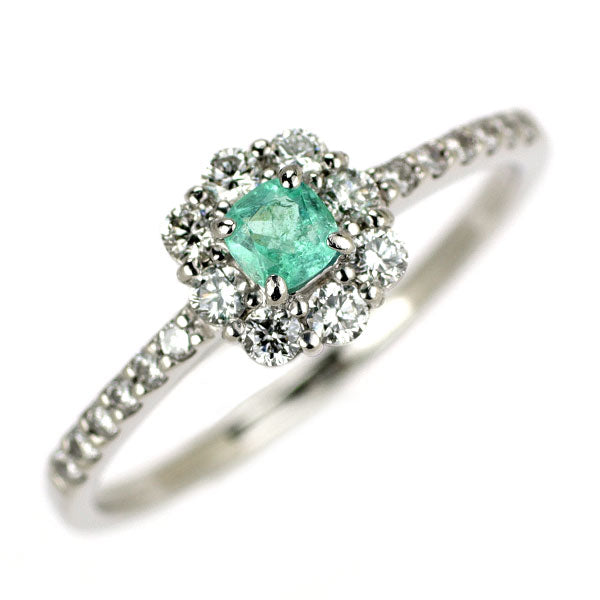
Comparison of bright neon-colored Paraiba tourmaline at Selby
Each stone of Paraiba tourmaline has its own unique color, ranging from blue to green, neon color, and region of origin. You can search for Paraiba tourmaline that suits your taste while checking the product details.
Compare by color
Check identification information
Status check OK
🔬 visual comparison
“Neon ON” vs. “Neon OFF”
What happens when the ingredients change?
Even stones of the same blue color can look completely different depending on their internal elemental composition. The figure below compares two tourmalines with different ratios of copper, manganese, and iron.
💎
⚡ Paraiba judgment ✅
A neon blue that seems to emit light from within. An ideal state in which Cu²⁺ is the main character and the influence of iron is minimized.
🔵
❌ blue tourmaline stop
A deep, calming navy blue. Even if it contains copper, iron is dominant and the neon feel disappears. Not certified by Paraiba.
⚠️ Common misconception: "If it contains copper, it's Paraiba" is incorrect
Detection of copper is only a "necessary condition" for Paraiba, not a "sufficient condition." As a result of a comprehensive evaluation of the chemical composition of copper and iron, as well as the final color saturation, brightness, and neon feel, it was determined to be "Paraíba Tourmaline."
🗺️ Comparison of production areas
Complete comparison of ingredient profiles of the four major production areas
Brazil, Mozambique, Nigeria, Ethiopia
Currently, GIA has widely handled three major producing countries: Brazil, Mozambique, and Nigeria. We will thoroughly compare four production areas including Ethiopia, which will attract attention from 2024 to 2026.
| Production area | Cu (copper) content | Mn (manganese) | Fe (iron) | neon color intensity | Differential treatment | market evaluation |
|---|---|---|---|---|---|---|
|
🇧🇷 Brazil
Paraiba and Rio Grande do Norte |
very high ~1.5 wt% |
Medium to high | extremely low | ⚡⚡⚡⚡⚡ | Widely distributed as Paraíba Tourmaline | Highest price range Rarity + best coloring |
|
🇲🇿 Mozambique
Cabo Delgado Province |
expensive ~1.0 wt% |
Medium | low to medium Varies depending on the stone |
⚡⚡⚡⚡ | Distributed as Paraíba Tourmaline | high price range Current main sources |
|
🇳🇬 Nigeria
Around Oyo and Kwara states |
Medium 0.3~0.8wt% |
Medium | low to medium | ⚡⚡⚡ | Distributed as Paraíba Tourmaline | Medium to high price range Wide range of quality |
|
🇪🇹 Ethiopia
(New production area/under investigation) |
Large fluctuation There are detection cases |
Large fluctuation | high tendency ⚠️ Noticeable in many stones |
⚡〜⚡⚡ by stone |
Under investigation/judgment varies by individual | Low to medium price range High grade is rare |
📊 Comparison image of “copper content” by production area * Conceptual relative comparison (actual values vary from stone to stone)
range
⚠️ Comparison image of “iron (Fe) content” by production area ─ The lower the better * Conceptual relative comparison
🇪🇹 Detailed analysis from Ethiopia
Why is it made in Ethiopia?
Is it difficult to be recognized as “Paraiba”?
Copper-containing tourmaline from Ethiopia has attracted attention as a "new production area" that will shake up the jewelry industry from 2024 to 2026. But reality is complicated.
🔍 Current situation of Ethiopian products: 3 challenges
Fe↑
High iron content
A noticeable trend
A noticeable trend
few
neon standards
Percentage of stones to meet
Percentage of stones to meet
Under investigation
GIA・SSEF
Official database
Official database
Issue 1: Many stones have high iron content
In many Ethiopian samples, while copper is detected, the iron content is also high, which cancels out Paraiba's characteristic neon color. The combination of ``copper and iron'' is a typical pattern that is judged by identification agencies to be ``blue tourmaline'' or ``copper-bearing tourmaline.''
Issue 2: Database not yet established
SSEF has released a preliminary report in 2026 stating that there is a possibility of a new production area in Ethiopia, but the Ethiopian reference data from major identification organizations including GIA is still immature. In some cases, origin determination itself is difficult.
Challenge 3: High grade is rare but exists
There is a possibility that there is an Ethiopian product with a good balance of copper and iron, and a neon feel. However, experts believe that because the ``Paraíba certification rate'' is low overall, it is unlikely to have enough of an impact to lower the overall market price.
Latest information 2026
🏛️ Latest news from SSEF (Swiss Gem Research Institute)
SSEF reports the possibility of a new copper-bearing tourmaline deposit in Ethiopia. Some of the submitted samples have ``considerable overlap'' in chemical composition with existing production areas (Brazil, etc.), making it difficult to determine the origin in some cases. On the other hand, it has become clear that many samples have high iron content, which limits their ability to meet Paraiba standards. We are at the stage where we are waiting for additional analysis and data accumulation in the future.
🔄 Judgment flow of identification organization (for Ethiopian products)
1
✅ Copper (Cu) detection
Copper ions (Cu²⁺) are detected by component analysis using LA-ICP-MS, etc. Clear with many stones even from Ethiopia. However, this is only the "first barrier".
2
⚠️ Evaluation of chemical composition of copper, iron, etc.
Precisely measure the ratio of iron and copper. Many of the stones from Ethiopia are determined to have too much iron. When the iron content is high, the neon effect tends to be evaluated as weak.
3
⚠️ Color saturation/lightness standards
"Neon properties" were confirmed by visual evaluation and spectroscopic measurement. Even at this stage, the stone from Ethiopia, which is rich in iron, was judged to be a ``too calm blue'' and was not certified as Paraiba.
4a
❌ Non-certified: “Copper-containing tourmaline”
Contains copper, but is dominated by iron and lacks color → The identification book states "Copper-bearing Tourmaline" or "Blue Tourmaline". Most of the products from Ethiopia fall under this category.
4b
✅ If the conditions are met: "Paraiba Tourmaline"
Sufficient Cu was detected, the effect of iron was small, and a neon appearance was confirmed → It was clearly listed in the identification book as "Paraíba Tourmaline". Stones of this quality from Ethiopia are currently extremely rare.
Comparison of bright neon-colored Paraiba tourmaline at Selby
Each stone of Paraiba tourmaline has its own unique color, ranging from blue to green, neon color, and region of origin. You can search for Paraiba tourmaline that suits your taste while checking the product details.
Compare by color
Check identification information
Status check OK
💹 market analysis
Ethiopian products are available in the existing market.
Will the price be lowered?
“New production area = increased supply = decreased price”As aboveSince we cannot expect an absolute number, it is predicted that the possibility of realization as a story is extremely low. We will analyze it from both gemological and market principles.
Certification rate wall
Currently, the percentage of stones produced in Ethiopia that can be identified as "Paraiba" is extremely low. There is not yet the ability to significantly increase the number of Paraiba-certified loose items on the market.
Risk of not having a certificate
There are concerns that there will be an increase in fraudulent transactions in which Ethiopian loose, which is distributed as ``copper-filled blue tourmaline,'' is mistakenly mistaken for Paraiba.This method will increase in the future, so be careful.
The value of Brazilian products remains unchanged
Brazilian blue is exceptional due to its historical and gemological rarity and overwhelming color quality. The appearance of Ethiopian products does not change the reputation.
future possibilities
The situation could change if high-quality veins with low iron content are discovered in the future. SSEF is continuing to accumulate data, and the impact on the market needs to be reevaluated over the medium to long term.
✅ Professional opinion: Limited impact on prices
``Even if Ethiopian stones contain copper, they tend to be iron-rich, so there are very few high-quality stones that can be recognized as Paraiba by identification, and this will not have a significant impact on lowering market prices.''This is the current view of many in the jewelry industry (rare stone collectors). However, from the perspective of consumer protection, it is more important than ever to confirm the origin and certificate of origin.
As of 2026, it is believed that there are only a limited number of stones produced in Ethiopia that can be evaluated as Paraiba Tourmaline. However, the research has just begun, and the evaluation criteria and classification may be revised in the future as data from major classification organizations such as GIA and SSEF accumulate. This article is based on information publicly available as of 2026.
Some experts and collectors are hopeful that as research on Ethiopian products progresses, the evaluation standards for chemical compositions such as copper and iron, as well as the certification standards for Paraiba tourmaline, may be revised. However, as of 2026, no such standard changes have been announced.
🛒 buying guide
Authentic Paraiba tourmaline
5 checkpoints to check
Now that the issue of Ethiopian products has come to the fore, it has become increasingly important to choose stones with the correct knowledge.
①
🏛️ Check the identification certificate from GIA/Central Gem Research Institute
Be sure to check that it clearly says "Paraíba Tourmaline". The descriptions of "Copper-bearing Tourmaline" and "Blue Tourmaline" do not indicate Paraiba. It is also important to state the origin.
*In the future, there is a possibility that conventional blue tourmaline and copper-containing tourmaline will be sold with a label such as ``There is no identification certificate, but this is Paraiba tourmaline from Ethiopia.'' Please be sure to check the contents of the identification document.
②
👁️ Check the neon feel under fluorescent lights/LEDs
Paraiba's original color does not lose its ``radiance as if it is emitting light from within'' even under fluorescent lights or LED lights. Be sure to check how it looks on cloudy days and with indoor lighting.
③
💰 Be careful of extremely cheap “Paraiba”
One carat of high-quality Paraiba from Brazil is priced in the hundreds of thousands of yen to several million yen. Items priced far below the market level are likely to be ``copper-containing tourmaline'' or ``treated stone.''
④
🌍 Confirmation of production area and consultation with experts
Rarity and price change in the following order: Brazil > Mozambique > Nigeria. Please seek professional advice, especially for products of unknown origin or Ethiopian products.
⑤
🔬 Check for presence of heat treatment
Paraiba tourmaline may also be heat treated. The description "Unheated" is an element that further increases rarity and value.
Comparison of bright neon-colored Paraiba tourmaline at Selby
Each stone of Paraiba tourmaline has its own unique color, ranging from blue to green, neon color, and region of origin. You can search for Paraiba tourmaline that suits your taste while checking the product details.
Compare by color
Check identification information
Status check OK
👤 Supervisor profile
Experts who supervised this article
💎
Saito (SELBY Jewelry Buyer/Supervisor)
Komehei Group's only jewelry specialist company SELBY
A rare stone specialist who inspects production areas around the world and directly imports loose stones. It is affectionately known as "Lethal Weapon" by local dealers and continues to share information with rare stone collectors around the world on a daily basis. He specializes in determining the authenticity and evaluating the value of rare gemstones such as Paraiba tourmaline, paudlettite, and sapphire. By disseminating gemological information, we are working to protect consumers and improve market transparency.